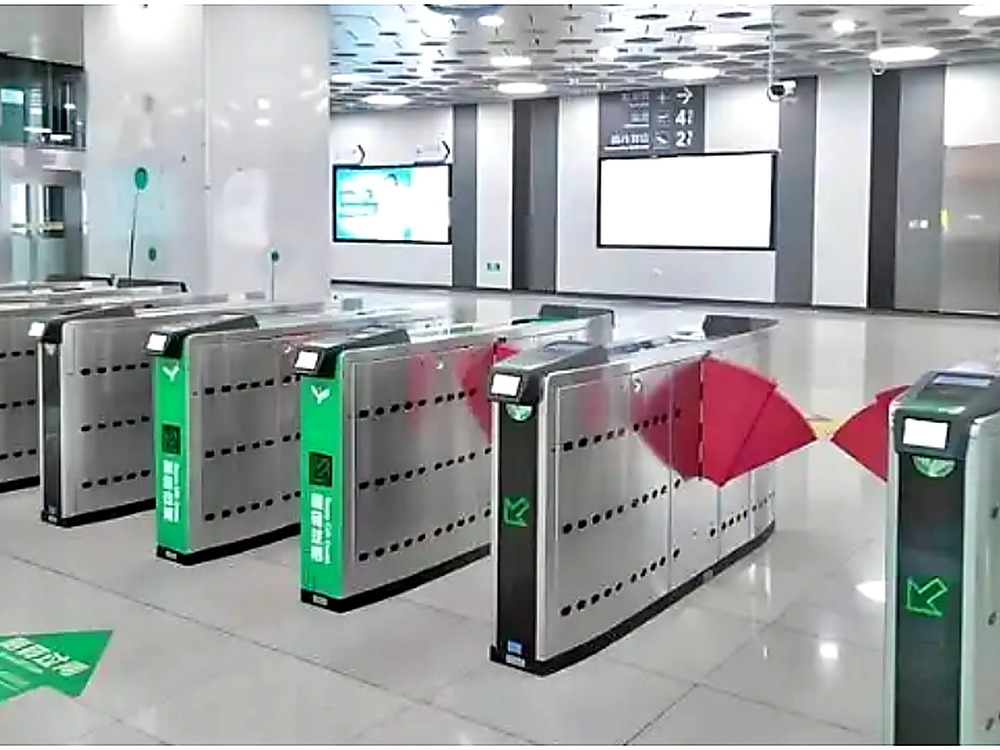
Through-beam photoelectric sensors are the standard sensing layer behind reliable metro fare gate operation — detecting passenger presence, tracking passage direction, and protecting the closing barrier. Whether the system can go a step further and distinguish an adult from a child, however, is not determined by the sensor alone. It depends on how the beams are arranged and how the controller interprets them. This article explains the detection principle, the configuration options, and what each delivers in practice.
-
Working Principle
A through-beam photoelectric sensor consists of two separate units — an emitter and a receiver — mounted facing each other across the gate lane.
When the beam is clear, the receiver continuously receives the light from the emitter and holds a steady output signal. When a passenger enters the lane and blocks the beam, the received light level drops and the sensor switches its output.
The gate controller monitors these transitions in sequence. By reading which beam is broken, in what order, and for how long, it determines that a passenger is present, counts the passage, resolves the direction of travel, and commands the barrier to open or hold.
-
Precise Detection Through Multi-Beam Arrays
A metro fare gate is rarely fitted with just one sensor pair. In practice, multiple through-beam pairs are installed at different heights and positions along the lane to build a detection field rather than a detection point. This array delivers:
Reliable sensing of passengers of all statures, including small children and wheeled luggage.
Direction discrimination, as the beam-break sequence reveals whether a passenger is entering or exiting.
Tailgating and reverse-intrusion detection for fare evasion control.
Anti-pinch protection, with the barrier held open while any beam in the safety zone remains interrupted.
For this duty, DASS through-beam photoelectric sensors — such as the DS-GT series — combine fast response with high stability, making them well suited to fare gates, where uptime, repeatability and immunity to ambient conditions are non-negotiable.
-
Can the System Distinguish a Child from an Adult?
The direct answer: not with a single beam, and not by the sensor alone.
A single through-beam pair outputs a binary state — blocked or clear. It reports that something is in the lane, not what it is. Height, body size and passenger category are beyond the information a one-bit signal can carry.
Adult/child differentiation becomes possible when beam layout and detection logic are designed together.
With a single horizontal beam at low height, the system determines presence only, with no classification. With beams at multiple heights forming a vertical array, the system can resolve an approximate height band, so a child who breaks only the lower beams is distinguishable from an adult who breaks the upper beams as well. When that vertical array is combined with spacing and timing logic, the system can identify an adult alone, a child alone, or an adult and child passing together — the case that matters most for safety. Once the array is integrated with the fare system, the detected profile can be correlated with ticket type, adult, child or concession, to flag mismatches.
Why this matters in operation: the highest-value scenario is not classifying a child walking alone, but detecting a child following closely behind an adult on a single valid fare. A low-mounted beam array keeps the safety zone active after the adult has cleared, so the barrier remains open instead of closing on the child. This is a configuration and logic outcome, delivered by the same DASS sensors, and it is why multi-beam layout is specified on modern fare gates.
Why DASS
High-speed response: 10 kHz switching frequency captures fast beam interruptions at full walking speed, with no missed counts during peak flow.
Immunity to ambient light: reliable operation under 100,000 lux of direct sunlight, a decisive advantage for fare gates at street-level or skylit station entrances.
IP67 protection: sealed against dust and water ingress, suited to the cleaning routines and humidity of underground stations.
Zero blind-zone detection: proprietary algorithms recover extremely weak reflected signals, eliminating the dead zone near the receiver that causes conventional sensors to miss small or low-contrast targets.
Stable, dense installation: engineered for side-by-side mounting with no mutual interference, so a full multi-beam array fits within a single gate housing.
Conclusion
Through-beam photoelectric sensors are a proven, high-reliability solution for passenger detection in metro fare gates. Their ability to distinguish a child from an adult is not a limitation of the sensor but a function of beam configuration and detection logic — and with a properly designed DASS multi-beam array, that capability is fully within reach.