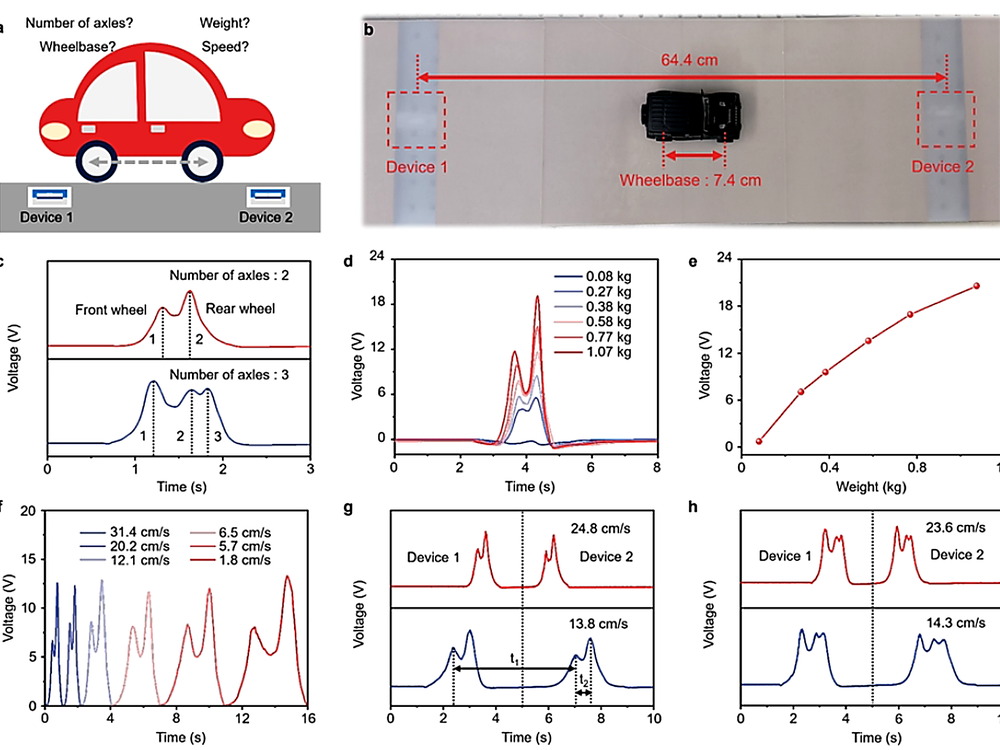
Embedded in the road surface, a single DASS piezoelectric pressure sensor turns passing traffic into actionable data — axle count, axle load, gross vehicle weight and speed — without ever interrupting traffic flow.
The technology is already well established worldwide: in the United States, Brazil, Germany, Japan and South Korea, piezoelectric sensors serve as the pre-selection layer for highway overweight and overload enforcement, and as the sensing front end of bridge overload warning systems. Across China’s intelligent transportation systems, the same principle supports vehicle classification and counting, speed measurement, red-light photo enforcement and more.
-
Weigh-in-Motion and Overload Monitoring
DASS piezoelectric pressure sensors measure the load of each axle as it passes, enabling true weigh-in-motion (WIM) at traffic speed. Measured weights are compared against preset statutory limits in real time; once a threshold is exceeded, the system raises an alarm and automatically logs the vehicle record — timestamp, lane, axle loads, gross weight and image capture — for downstream enforcement. Because suspect vehicles are pre-screened in the running lane, enforcement resources focus only on the few that matter, instead of diverting all traffic to a static scale.
-
Vehicle Classification and Traffic Statistics
From a single pass, the sensor array resolves axle count, axle spacing, axle load and gross weight. The ITS controller uses these features to classify vehicles into light, medium and heavy categories, generating accurate traffic-volume and fleet-composition statistics for road authorities — the data foundation for pavement design, load rating and transport planning.
-
Speed Measurement
Two or more sensors installed at a fixed spacing along a lane measure the time a vehicle takes to travel between them, and speed is derived from the known distance. The method is accurate, repeatable and completely non-intrusive: no overhead gantry, no external radiation, and no effect on driving behaviour.
-
Traffic Data Collection and Dissemination
Sensor data — flow, speed, vehicle class — is streamed to the ITS central controller, which dynamically retimes signals, balances load across lanes and eases congestion. The same feed powers traveller-information services, giving drivers real-time road conditions so they can plan the optimal route.
Why DASS
High-fidelity dynamic measurement — fast response captures the short-duration axle impacts that slower sensing technologies miss, keeping accuracy stable across the full speed range.
Flexible thin-film form factor — a bendable, conformable structure that bonds to or embeds in the road model with minimal civil work and no lane-closing construction.
Engineered for the road environment — wide operating temperature range, resistance to moisture and electromagnetic interference, and long service life under repeated wheel loading.
Customisation as standard — size, measuring range, sensitivity, array density and output interface are all configurable to the lane geometry and the enforcement standard in force.
Conclusion
Piezoelectric pressure sensors play a vital role in intelligent transportation system monitoring. By precisely measuring vehicle weight and speed, they give traffic authorities the accurate data they need to optimise traffic flow, reduce congestion and raise the throughput of the road network.